Industrialism and Mechanization
Lady Chatterley's LoverIndustrialism and Mechanization in Lady Chatterley’s Lover are at once an economic system, a visible transformation of the Midlands, and a governing idea about what counts as useful life. The mines supply energy and employment, but their machinery and commercial imperatives also reorganize the landscape, work, and social relations around Wragby. The novel gives this order both practical force and human cost: Clifford finds purpose and power in industrial management, while Connie and the narrative register the pollution, insecurity, and estrangement that accompany it.
Industrialism in the Landscape
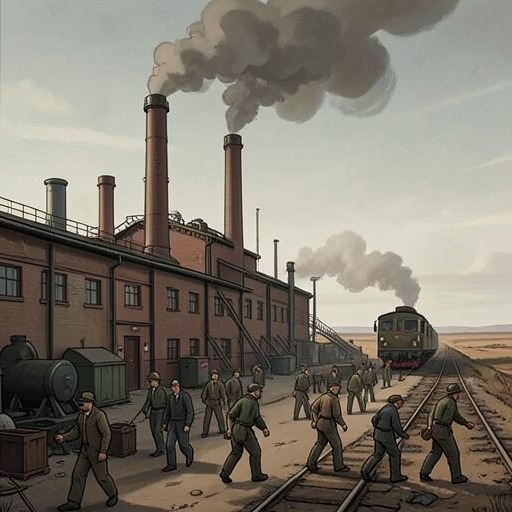
Wragby stands on an eminence among old oaks, but its view is inseparable from the nearby Tevershall pit and village. Tevershall’s small, begrimed houses stretch from the park gates, while smoke and steam rise from the colliery. The contrast is not between an untouched countryside and a remote factory: industrial activity presses directly against the estate and its wooded surroundings. Connie, accustomed to other English landscapes, initially takes in the Midlands’ ugliness as something nearly impossible to contemplate, then becomes accustomed to it. That adjustment suggests how an extraordinary environmental change can settle into the everyday.
The industrial burden is material and persistent. The Tevershall pit-bank has burned for years; the expense of extinguishing it means that it continues to burn. Its sulphurous smell sometimes fills the house, and even when the wind is still, the air carries traces of coal, iron, sulphur, or acid. Soot settles on the Christmas roses. The novel links this damage to a wider sensory world of colliery noise: screens rattle, winding engines puff, trucks clink, and locomotives whistle. These are not merely distant signs of production. They enter the domestic atmosphere and make the mine’s presence difficult to escape.
The wood, too, bears the imprint of industry and ownership. An old riding through the trees, once a country thoroughfare, has become a route through private woodland. During the war Sir Geoffrey cut trees for trench timber, leaving a denuded knoll of stumps and burned brushwood. From its exposed crown, the colliery railway and the new works at Stacks Gate come into view. The cleared ground creates a breach in the wood’s seclusion: industrial development becomes visible through a wound in the landscape, while Clifford’s anger at the destruction coexists with his own commitment to controlling and protecting the estate.
Coal, Machinery, and the Future of Work
Industrialism is also presented through the changing fortunes of coal communities. Tevershall and New London are the two collieries described as still operating, but both face difficulty. Tevershall, once a famous and profitable mine, is said to be nearing decline; New London is less prosperous and especially vulnerable in bad times. Workers have left for Stacks Gate and Whiteover, where newer industrial works offer different employment. The prospect of Tevershall’s eventual closure threatens more than the mine’s owners: it unsettles a community that has long organized its life around the pit.
Mechanization sharpens that uncertainty. The new mines work at greater depths and depend on machinery, including coal-cutting machines that workers call iron men. Their use can reduce wage costs, even as it displaces or diminishes the role of miners. The account also recalls earlier technological change, such as the abandonment of stocking frames, to show that anxiety about machines has a history. Yet the suggestion that machinery may lead to a world with no use for human labor remains a disturbing possibility, not a settled prediction. The evidence holds together competing pressures: machines may increase production and save costs, while industrial towns and their workers remain exposed to closures, migration, and changing demand.
The new chemical works at Stacks Gate extend this transformation beyond coal extraction. They are described as deriving substantial value from coal’s chemical by-products, and their different technology distinguishes them from an ordinary colliery. The fact that Tevershall coal is said not to yield the same chemicals, despite the mines being less than three miles apart, helps explain why local proximity does not guarantee shared prosperity. Industrial development follows the qualities of its resources and the calculations of its operators, not simply the needs of the nearest workforce.
Clifford’s Industrial Ambition
Clifford’s return to the mines turns industrialism into a personal project as well as a social condition. After years focused on literary work and public recognition, he begins to feel that he belongs to Tevershall’s mining world and to understand himself as its real boss. He revisits the mine, descends in a tub, and is shown a coal seam by the underground manager using a powerful torch. He then studies technical works, government reports, and German writing on mining and coal chemistry. His attention shifts from literary fame to the technical possibilities of production.
That shift brings a pronounced change in his sense of agency. Clifford questions managers and engineers, visits the pit repeatedly, and experiences authority over the colliery workforce as a new form of power. The mine’s stale air, rather than repelling him, becomes associated with a revival of purpose. He sees technical work as a way of getting beyond the inwardness he associates with his earlier life, and he imagines pulling Tevershall out of difficulty. Industrial work is therefore not represented only as an external evil: it offers Clifford an effective role and a concrete field of action.
His project moves from considering the conversion of coal into electricity to experimenting with a concentrated fuel that would burn slowly at intense heat. A young chemist assists him, and Clifford considers the fuel in relation to a new locomotive engine designed to operate without a fireman. These plans show the ingenuity and reach of industrial science, but they also reveal the limits of Clifford’s renewal. His growing technical command does not establish a corresponding concern for emotional or human life; the narrative places his excitement about industrial intelligence beside its judgment that technical prowess can coexist with immaturity in human relations.
Production, Power, and Social Division
The novel connects industrial management with political claims about order. In conversation, the industrial ideal is compared to a machine composed of separate, equally necessary parts, with the individual subordinated to the larger mechanism. The comparison is applied both to collectivist political thinking and to the factory owner’s ideal. The point is not that these systems are identical in every respect, but that both can imagine society through mechanical organization and suppress the value of personal, organic life. Industrial efficiency thus becomes an idea about how people should be arranged as well as a method of producing goods.
Clifford’s emerging policy toward labor makes this power concrete. He claims that, if the mines are properly managed, there will be no more strikes because strikes can be made nearly impossible. This is presented as managerial control rather than a resolution of workers’ grievances. Connie challenges the distance between ownership and workers’ lives by pointing out that the people’s existence is industrialized through Clifford’s coal mine. Clifford answers that no man is forced to work for him and treats each person’s livelihood as an individual matter. The disagreement exposes a conflict between formal choice and material dependence: the language of individual freedom does not settle the question of how a community’s available work has been shaped by the mine.
This conflict is sharpened by the contrast between two kinds of success. Clifford has earned recognition through writing, but he comes to distinguish the audience for entertainment from the population that performs industrial work. The latter, on whose labor production depends, is less visible and more exposed to hardship. Industrial wealth and literary fame are not identical forms of achievement, yet the narrative places them within a shared economy of success, attention, and power. Clifford’s desire to enter industrial production means seeking authority in a harsher arena than the world of publicity he previously inhabited.
The Novel’s Critique and Countervision
The wider critique treats industrialism as a force that separates people from bodily experience and from one another. In this account, commercial possession and mechanical efficiency displace spontaneous feeling and physical contact; the result is not simply less sensuality but a more superficial performance of life. The novel’s emphasis on physical work offers a counterpoint to both business ownership and labor reduced to an alienated process. Its alternative is not developed as a technical program for the mines. Rather, the importance of bodily labor and contact supplies a standard by which the industrial order’s abstractions can be judged.
Nature does not provide an entirely secure refuge from that order. The wood retains old paths, trees, and clearings, but the war’s timber cutting, the railway, the works, industrial lights, and the sounds of mining repeatedly penetrate its apparent solitude. The wood’s vulnerability makes the contrast with industrial development tangible without allowing an easy division between pure countryside and modern industry. The same society that treats land as property and resource also makes withdrawal from its machinery increasingly difficult.
The novel’s treatment of industrialism is consequently double-edged. The mines generate employment and technical possibilities, and Clifford experiences their administration as a source of renewed purpose. At the same time, their pollution, unstable economic prospects, mechanized labor, and concentration of managerial power make them central to the crisis of human and communal life. Industrialism and Mechanization name the novel’s pressure point: a civilization capable of remarkable technical invention but liable to organize land and people as components of production, leaving human connection and bodily life diminished.